How To Install Plugins For Imagej
Most commands in ImageJ are implemented as plugins but these internal plugins are located in the ij.jar file, not in the plugins folder. Ij.jar also contains the properties file (IJ_Props.txt) that ImageJ uses to install internal plugins in menus. A JAR file (Java ARchive) is formatted the same as a ZIP file, so you can use a ZIP utility to look at the contents of ij.jar. User Manual for the ImageJ plugin. How to install: 1. Copy the “ColonyArea” folder with its 6 files into the “Plugins” folder of the.
ThunderSTORM is written in Java and is distributed under the terms of the GNU GPLv3 license as a plugin for ImageJ. The official download site for the latest version of ImageJ is accessible. Note that ImageJ requires the Java Runtime Environment (JRE) to be installed.
How To Install Plug-ins Youtube

If you do not have JRE installed, download a bundled version of ImageJ & JRE for your platform. We recommend using the 64-bit version of Java for a 64-bit operating system. To install the ThunderSTORM plugin for the first time, the latest version, rename the file to ThunderSTORM.jar, and copy it into the plugins subfolder of your ImageJ installation.
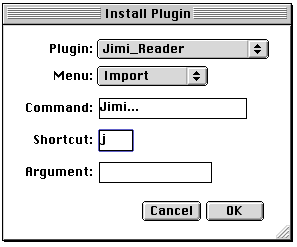
The location on a Windows system is C: Program Files ImageJ plugins ThunderSTORM.jar, for example. To verify successful installation of ThunderSTORM, run ImageJ. There should be an item called ThunderSTORM in the Plugins menu of ImageJ. If the item does not exist, make sure that the file name ThunderSTORM.jar is correct as it has to contain the underscore ( ) character.
Compatibility notes. ThunderSTORM has been tested on Windows XP (32b), Windows 7 (32b/64b), Debian and Ubuntu Linux (32b/64b), and MacOS X 10.8.5. ThunderSTORM is compatible with ImageJ based applications such as Fiji and μManager. ThunderSTORM is compiled for Java 1.6 and is compatible with ImageJ 1.45s or later. Input / Output. Images – all image formats supported by ImageJ and its plugins.
Molecular localizations and ground truth data – CSV, XSL, XML, YAML, JSON, Google protocol buffer, and Tagged Spot File (TSF) format. Help with ImageJ The official ImageJ documentation is available. Help with ThunderSTORM To get help with using ThunderSTORM, please consult or the project. To get help related to a specific function, click on a blue icon with a question mark next to a particular control panel. A detailed description of algorithms used for the data analysis is also available in the. Initial settings of ImageJ Since data acquired by Single Molecule Localization Microscopy (SMLM) are usually very large (several GB) and processing the data is computationally demanding, we recommend setting the number of processing threads equal to the number of available CPU cores. It is also crucial to set the memory limit to the highest possible value, but at the same time to keep enough memory (2 GB) for the operating system.
For example, our setup uses a computer with an Intel i5 (4 cores) processor and 32 GB of RAM. Madd victim impact program los angeles. We set the number of processing threads to 4 and the memory limit to 30 GB. To decrease memory consumption, load your data as a virtual stack (see ImageJ documentation). To set the number of processing threads and the memory limit in ImageJ, select Edit → Options → Memory & Threads.
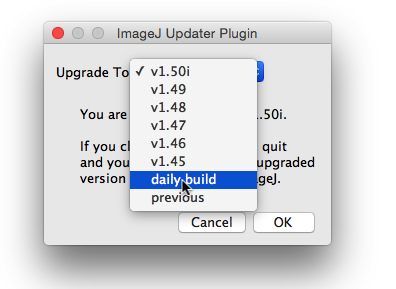
Updating ThunderSTORM ThunderSTORM has an integrated updater. From ImageJ, select Plugins → ThunderSTORM → Check for updates. And select the version you want to upgrade (or downgrade) to, and click OK. If the updater cannot be used for some reason, download the latest ThunderSTORM.jar file from the project website, and copy it into the plugins subfolder of your ImageJ installation. Please restart ImageJ before running the updated version of ThunderSTORM. Report a bug Prior to submitting a bug report, please upgrade to the latest version of ThunderSTORM and see if the error still occurs. Note that due to recent changes on Google Drive, previous versions of ThunderSTORM (.