Atma Darshan Krishna Menon Pdf Reader
ATMA-DARSHAN - AT THE ULTIMATE [Sri Krishna Menon Atmananda] on Amazon.com. *FREE* shipping on qualifying offers.Missing. Atma Darshan Atma Nirvriti. Atmananda Krishna Menon - Wikipedia. He has been described by scholars as a. Krishna Menon in 1. Darshan Museum; Books and Music. Jan 1, 2018 - Download free Atma Darshan Krishna Menon Pdf. Atmananda Krishna Menon. In the preface to. The Truth is by Sri H. Atma darshan shri atmananda krishna menon Poonja.Ananda. This 45 page book can transform anyone - If the Reader is ready (ripe enough) to realize the Ultimate Truth.
By Peter Holleran Shree Atmananda (1883-1959) was a modern day sage who taught a Vedantic approach to self-realization, and was well- respected by Paul Brunton and others. Brunton himself would send people to Atmananda desiring a traditional guru-disciple relationship, a function that he himself as principally a writer did not provide. Atmananda was a sage among sages who had attained proficiency in all yogas prior to assuming his principle role of teaching jnana.

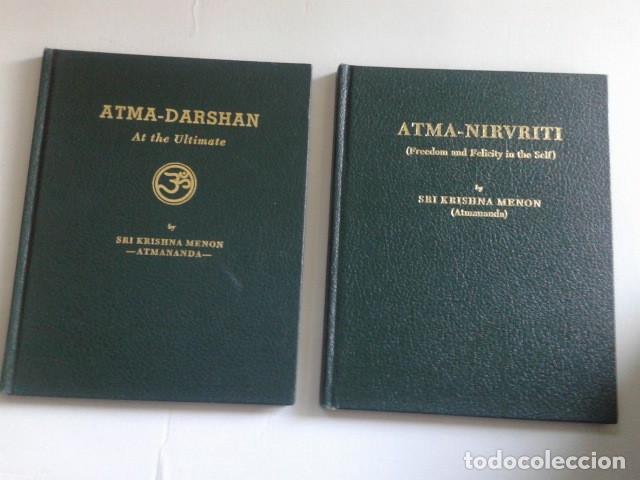
John Levy and Walter Keers were influential in bringing his work to the attention of the West, with Levy personally assisting Atmananda in the English translation of his works Atma Darshan and Atma Nivriti. Atmananda urged Levy to promote his teachings in a more accessible form, and to that end Levy wrote The Nature of Man According to Vedanta and Immediate Knowledge and Happiness (Sadhyomukti), while teaching students out of his home in London. Not a believer in w orld-denying asceticism, Atmananda had a wife and fami ly as well as a demanding career in la w enforcement. He went so far as to encourage others to take up the same line of work, affirming that spiritual realization achieved under such conditions was enduring, final, and much stronger than realization gained in an ashram or monastery. Atmananda held firmly to the conviction that the only thing one had to renounce for liberation was the ego, and this itself was only possible through the light of knowledge, or spiritual insight, and not through motivated self-effort directed towards some goal outside of the self. When he was but ten years old, Krishna Menon (later Atmananda) was visited by a s annyasin of some repute and given an initiation into a form of mantra yoga. He practised assiduously for several years but by his early teens became convicted by the ratio del of western education and “converted” to atheism.
He went on to university and then law school after which he became prosecuting inspector for the police department in Trivandrum. The spiritual quest soon got his attention again, however, and he began spending sleepless nights drenched in tears, agonizing over his need for God. He became convinced through his study that it was only a realized guru who could give him the help that he needed, and he was in constant mental torment over wh a being would appear.
Not long after his tumult began he came upon the sannyasin he had met as a child, who as a Menon met his master of re raphy of a Y ogi, Paramahansa Y gged for spiritual instruction an. Atmananda said that Lewis had an 'intense s truggle' for a month after leaving his body.' (2a) One must keep in mind that even the great non-dualist Sankara wa s a bhakta, tantric, jnani, as well as yo gic adept with advanced siddhis, and not just a verbal-oriented philosopher.
That there are depths to realization that are not merely random accessories to the 'real thing', then, hardly seems arguable except within more narrow advaitic circles. After a few years Krishna Menon began having long stret ches of nirvikalpa samadhi, but, nevertheless, like Brunt on after his time with Ramana Maharshi, remained unsatisfied. He therefore took up the path of jnana and in 1923 achieved what seems to have been the penetration of the root of attention and the ego-I in jnana samadhi, or the Witness consciousness. Soon afterwards he inwardly received the name “Atmananda” from his guru and was referred to by that name from then on. Like Nisargadatta and so many others, after his realization he wanted to take up the path of the wandering renunciate, but again his guru appeared to him in a vision and advised him to remain a householder, serving his wife and family and society, while preparing for the devotees who were to come in the future. Atmananda retired from the police force in 1939, having risen to the level of District Supervisor (the equivalent of District Attorney in the United States).
His later writings suggest his initial realization matured into sahaj, or the realization of the Soul, Consciousness Itself (or Overself as designated by Brunton). Atmananda, for instance, told a person who was an adept at entering the highest mystic trance of nirvikalpa that such was good, but that it was not the highest state, and that it was now necessary for him to “understand the world through the mind’s intelligence.” This is similar to the Chinese sage Huang Po, who said. (3) While the Witness has been referred to as the “awareness of awareness,” the realization in sahaj is that of “awareness itself, whether the world arises or not.” In this realization the “eyes of the heart” open and all is recognized as being non-separate from the reality of Mind or Consciousness. In the intermediate stage, that of the Witness Self, itself impersonal, there is a relative freedom in the midst of phenomena, but the greater recognition or insight has not yet dawned. There is a final stroke yet to go.
While necessary, the realization that the knower is separate from the known, the witness different from the witnessed, must be gone beyond and both realized as one and inseparable. Paul Brunton explains that in the ultimate stage. The common initial psychological effect of penetrating to the heart-root or the witness position in in jnana samadhi or its equivalent, nevertheless, is that one tends to distance himself from the body and the world by his abidance in the Witness consciousness. He does not necessarily yet realize the origin and nature of all apparent objects as Consciousness Itself, which takes understanding and time to mature into a lasting state of sahaj. This may have been the case with Ramana Maharshi in the early years after his first awakening. He only gradually adapted his awakening to active life in the body.
The eminent Krishnachandra Bhattacharya, in my opinion, attempts to describes, in Sam 'khya fashion, the Witness stage as follows. 'Freedom from ahamkara does not by itself mean knowledge or realization of the self (or isvara). It is in the first instance a merging or forgetting of the self in a tattva higher than ahamkara, a free identification of the self with infinite buddhi - either in the form of feeling or in the form of willing. Free identification means identification in the explicit subjective attitude as distinct from unconscious or erroneous identification which impllies the objective attitude and the conceit of the body.”. 'European psychology has not gone beyond personality, has not reached the Witness. This is because unless one's min d is sufficiently sharp the notion of the Sakshin cannot be seen.
One must perceive that the I itself comes and goes, as in sleep for instance. What it is that perceives this? It is the Witness. The I is an object, the Witness is the subject. This position is the next step ahead of Western psychology. It much be reached, mastered and then dropped for the next higher step, the understanding of the Atman. The Witness-self is not an individuality, it is universal, but still it is a temporary stage, not the ultimate truth.
It is for beginners and here Maharishi's 'Who AM I?' Analysis is most useful as it shows beginners that the I comes and goes, and that they must look beyond it to the principle of Awareness which tells you of these appearances and disappearances of the I. But beyond that point the Witness self, the Sakshin, the Maharishi's teaching does not go. Higher than his is the doctrine of the Atman. The notion of the Witness arises o nly when you consider the objects from this standpoint wh ich assumes the real (not ideal) existence of all objects, the antithesis of a subject; a Witness must arise. But there is a loftier standpoint wherein the objects are dismissed from consideration entirely through the use of avastatraya an analysis of the three states and thus non- dual Atman is reached.But that is not the end. We have to know all the world, and we have to know the real I.'
'.The notion of Atman as the Witness or kno wer, of the three st ates is not the ultimate position. But we are forced to adop t it as a preliminary step. 282-283) Thus, the transcendental W itness consciousness realized in jnana samadhi (and touched upon but not necessarily as accurately understood in ascended nirvikalpa samadhi) is not yet realization of the Overself or Soul, which is not the “witness' of anything, but the very heart or condition of which everything is an apparent modification and in which everything arises, changes, and disappears. The Soul in sahaj is realized when it is discovered that the transcendental consciousness is the source not only of the ego-I, but of the body, mind, and the world of relations as well, and the exclusive tendency of attention to invert upon itself is transcended. The Witness is let go and Being, the natural state, alone remains.
One passes from Emptiness to Fullness. Thus, there is often this two-stage process. One realizes, as Anthony Damiani once stated, that the Witness, which at first seems like a stupendous realization, is not that pure, and that there is a further awakening (He nevertheless confessed to knowing himself as the witness self, and described it, with feeling, as 'peace, peace, peace'). 'Whoever speaks of the oneness of things must first of all prove the illusory nature of the external world. Th en alone can unity be proven.'
Atma Darshan Krishna Menon
2, 1827) 'T ruth is not to be got by thinking only, you can go on thinking about the world until the end of tim e but you will only get one thought following another thought. On the other hand, neither is truth to be found by not-thinking. Thus the question of truth never arises in sleep or nirvikalpa, a non-thought state. The two must be combined in order to discover truth.'
Dr. Krishna Menon
Contents. Biography Early life He was born as P. Krishna Menon in 1883 at Cherukulathu House, in, near, in the state of, now a part of. After completing his the study of law, he became a Government Advocate and Inspector and and remained in service until 1939. Sadhana and realization Meanwhile, his search for a guru led to his meeting Swami Yogananda (not to be confused with ) briefly in 1913. In 1923, he assumed the name Sri Atmananda and started teaching.
After retirement from government service, he resided in his family home, Anandavadi on the river in Malakara. He died at Trivandrum (now known as ) in 1959. Legacy He published several books including, and in (both of which he translated into English), and Atmaramam (in Malayalam). After his death, the book, based on tape-recorded talks between Sri Atmananda and some disciples, was published. In the following years, his eldest son Adwayananda continued his teachings from his home in Anandawadi, Malakkara, near, till his death in 2001.
A school in his name, was founded in 1987 in Malakkara, and another was located in from 1995 to 2011. When American mythologist visited India (1954–1955), his meeting with Krishna Menon has been described as the 'climax of his visit' to India, and is recounted in his book, Baksheesh and Brahman, and the meditation he was given, 'Where are you between two thoughts?'
His teachings have become a foundation for a spiritual method called the Direct Path. Bibliography. (Malayalam and English). Advaita Publishers,1983. (Malayalam and English), Advaita Publishers, 1983.
Atmaramam (in Malayalam). Advaita Publishers, 1983.
References. Lucas, Phillip (2004). New Religious Movements in the Twenty-first Century. New York: Routledge. Godman, David (2000).
Be As You are. Penguin India. Lucas, Phillip (2004). New Religious Movements in the Twenty-first Century. New York: Routledge. Pp. 306, 312. Richard Whittaker, October 23, 2009.
Atmananda Krishna Menon
Robin Larsen; Stephen Larsen; Antony Van Couvering, eds. New World Library. Godman, David (2000). Be As You are.
Penguin India. Lucas, Phillip (2004).
New Religious Movements in the Twenty-first Century. New York: Routledge.
Pp. 306, 312.